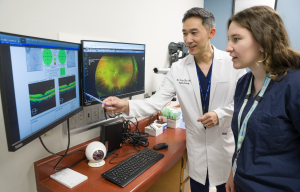
A Medventions-born startup bringing AI-powered, dye-free visualization to ophthalmic surgery.
In modern surgery, precision is everything, but even the sharpest scalpel cannot fix what the eye cannot see.
That reality is especially clear in ophthalmic procedures, where surgeons often operate on nearly invisible tissues. To visualize these delicate structures, clinicians frequently rely on chemical agents. While effective, staining adds time, cost, and potential risk. For many ophthalmologists, this has long been accepted as part of practice, even as surgical techniques and technologies continue to advance.
Oculum emerged from this tension. Born out of the Medventions Toronto program at Sunnybrook, the startup brings together engineers and ophthalmologists to address one of eye surgery’s most persistent challenges. Their goal is to develop a real-time, AI-powered visualization system that enhances what surgeons can see during procedures, without the need for dyes or changes to existing workflows. The team often describes the system as the lane assist of the operating room.
For Olga Klushina, a biomedical engineer in training and Oculum’s founder, Medventions offered a rare opportunity to immerse herself in real clinical environments. Before the program, she had little firsthand exposure to surgery. Through sustained observation in clinics and operating rooms, and ongoing dialogue with clinicians, the team began documenting inefficiencies and risks embedded in everyday practice.
Seeing the Challenge More Clearly
For Dr. Gary Yau, the clinical lead for Oculum, a practicing ophthalmologist and a Medventions mentor, innovation begins with acknowledging everyday limitations in clinical practice.
“As clinicians, we understand the realities and constraints of surgery,” he explains. “But we are not always involved early in the design of the tools we use. Working alongside engineers brings a different way of thinking about problems we deal with every day.”
During routine surgeries, Dr. Yau and his colleagues reflected on how often visualization depended on staining transparent tissues. If visibility was insufficient, dyes were added, increasing complexity and introducing trade-offs that were not always ideal.
“A dye-free approach has the potential to change how we work,” he noted. “Better visualization could improve efficiency and reduce risk.”
Those observations resonated strongly with Olga and the engineering team, particularly as they continued mapping clinical workflows and identifying pain points across ophthalmic procedures.
"As clinicians, we understand the realities and constraints of surgery. But we are not always involved early in the design of the tools we use. Working alongside engineers brings a different way of thinking about problems we deal with every day."
Dr. Gary Yau
A Unique Collaboration, Grounded in the OR
For Dr. Brian Ballios, an ophthalmologist with engineering training prior to medical school, Medventions offered a practical way to connect design, discovery, and clinical care.
“I have always been interested in applied science,” he said. “Medventions felt like an opportunity to bring technologies closer to practice, especially at that early stage where ideas are nearly ready but need real clinical grounding.”
Working with the Medventions fellows, he observed how quickly they immersed themselves in clinics and operating rooms. The fellows focused on understanding workflows, identifying bottlenecks, and documenting challenges that clinicians often manage intuitively.
“It was incredibly helpful to see those challenges structured and reflected back to the care team,” Dr. Ballios said. “Engineers are very good at crystallizing problems, setting clear objectives, and thinking about how success can be measured.”
Over the course of the program, the team identified more than 20 unmet needs in ophthalmology. One issue kept resurfacing: the inefficiencies and risks associated with dye use.
“At first, we assumed staining was simply the gold standard,” Olga said. “But after observing supply issues and the time it added to procedures, we started asking whether it was truly necessary.”
That question became the foundation for Oculum.
Oculum’s Breakthrough: A Dye-Free, AI-Guided Imaging System
Oculum’s technology uses AI-powered, real-time imaging to enhance visualization of delicate, transparent tissue structures without chemical staining. Designed to integrate seamlessly with existing surgical microscopes, the system supports surgeons without requiring changes to familiar techniques.
Dr. Kenneth Eng, ophthalmologist specializing in vitreoretinal surgery and a Medventions mentor, saw this balance as critical. Despite the advanced technology within ophthalmology, surgery itself remains largely analog, and most surgeons continue to prefer traditional microscopy over fully digital systems.
“What impressed me was how the team combined digital imaging with our desire to retain traditional visualization,” he said. “They recognized that surgeons value familiarity, while still seeing the opportunity to improve how tissue is visualized.”
In procedures such as macular hole surgery, the impact could be significant. Currently, surgeons stain the internal limiting membrane to make it visible for peeling. Oculum offers a way to visualize these structures more clearly, potentially reducing steps, time, and reliance on dyes.
The system’s modular design also allows it to be applied across other ophthalmic procedures, including cataract and corneal surgeries, extending its relevance beyond a single use case.
“What impressed me was how the team combined digital imaging with our desire to retain traditional visualization. They recognized that surgeons value familiarity, while still seeing the opportunity to improve how tissue is visualized.”
Dr. Kenneth Eng
The Road Ahead: From Prototype to Practice
Today, Oculum is advancing its minimum viable product with support from several Canadian innovation programs. Olga continues to lead technical development, working closely with ophthalmologists and using real-world surgical data to refine the AI system.
“I want every patient undergoing eye surgery to benefit from the highest standard of care,” she said. “And I want to give surgeons tools that enhance what they already do well.”
Clinicians involved in the project describe Oculum not as a replacement for surgical judgment, but as a subtle support in the operating room. Like lane assist in modern vehicles, it offers guidance that becomes most valuable when visibility is limited.
A New Vision for Surgical Innovation
Oculum’s journey reflects what is possible when clinicians and engineers collaborate early, grounded in real clinical environments. By focusing on shared challenges rather than technology for its own sake, the team was able to reimagine a long-standing aspect of ophthalmic surgery.
It is a reminder that meaningful innovation often begins not with disruption, but with careful observation, mutual respect, and a willingness to ask whether established practices can be improved.